Chemistry Homework Comprehensive Grading Report

Detailed audit of all 10 assignment sheets across Lessons 5 to 9 • Every question includes complete original prompts, choices, tables, student answers, accuracy evaluations, diagnostic feedback, and high-resolution original image scans.

105
Total Questions Audited
66
Correct (62.9%)
8
Partially Correct (7.6%)
31
Incorrect / Blank (29.5%)
70.0 / 105
Weighted Score (66.7%)
Sheet 1 / 10 • Lesson Five Homework (Part I & II)
微信图片_20260828182327_48_91.jpg
🔍 Click to view original handwritten sheet image (Sheet 1)
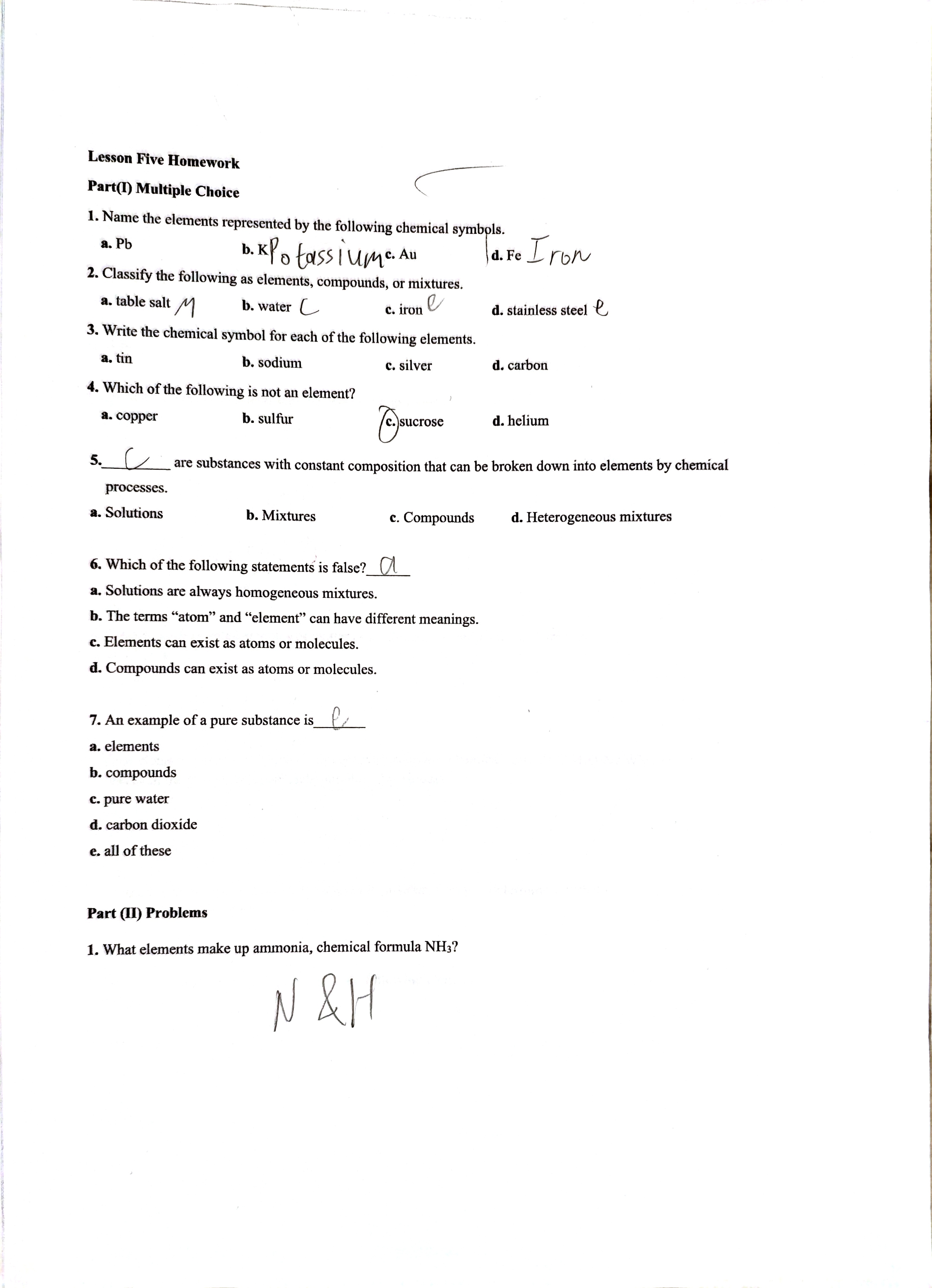
Lesson 5 Homework Page 1 Original Scan
Part I - 1a. Name the elements represented by the following chemical symbols: Pb
INCORRECT (BLANK)
Student's Handwritten Answer
[Left completely blank]
Correct Reference Solution
Lead
Diagnostic Analysis
The question was left unanswered. The chemical symbol Pb originates from the Latin name plumbum, which designates the element Lead (atomic number 82).
Part I - 1b. Name the elements represented by the following chemical symbols: K
CORRECT
Student's Handwritten Answer
Potassium
Correct Reference Solution
Potassium
Diagnostic Analysis
Accurate. K represents Potassium (derived from Neo-Latin kalium).
Part I - 1c. Name the elements represented by the following chemical symbols: Au
INCORRECT (BLANK)
Student's Handwritten Answer
[Left completely blank]
Correct Reference Solution
Gold
Diagnostic Analysis
The question was left blank. The symbol Au comes from the Latin word aurum, meaning Gold (atomic number 79).
Part I - 1d. Name the elements represented by the following chemical symbols: Fe
CORRECT
Student's Handwritten Answer
Iron
Correct Reference Solution
Iron
Diagnostic Analysis
Accurate. Fe represents Iron (from Latin ferrum).
Part I - 2a. Classify the following as elements, compounds, or mixtures: table salt
INCORRECT
Student's Handwritten Answer
M (Mixture)
Correct Reference Solution
Compound (C)
Diagnostic Analysis
In introductory chemistry curriculum contexts, pure table salt is sodium chloride (NaCl). It is a chemical compound consisting of sodium (Na⁺) and chlorine (Cl⁻) ions chemically bonded in a fixed, constant 1:1 stoichiometric ratio. It is classified as a Compound (C). (Note: On Sheet 2, the student correctly classified table salt as C, indicating earlier hesitation).
Part I - 2b. Classify the following as elements, compounds, or mixtures: water
CORRECT
Student's Handwritten Answer
C (Compound)
Correct Reference Solution
Compound (C)
Diagnostic Analysis
Accurate. Pure water is H₂O, a chemical compound.
Part I - 2c. Classify the following as elements, compounds, or mixtures: iron
CORRECT
Student's Handwritten Answer
e (Element)
Correct Reference Solution
Element (e)
Diagnostic Analysis
Accurate. Iron (Fe) is a pure element.
Part I - 2d. Classify the following as elements, compounds, or mixtures: stainless steel
INCORRECT
Student's Handwritten Answer
e (Element)
Correct Reference Solution
Mixture (M)
Diagnostic Analysis
Stainless steel is an alloy—a solid solution primarily made of iron, carbon, and chromium. Because alloys are physical blends of different elements that are not chemically combined in fixed stoichiometric proportions, stainless steel is a homogeneous mixture (M), not an element.
Part I - 3a. Write the chemical symbol for each of the following elements: tin
INCORRECT (BLANK)
Student's Handwritten Answer
[Left blank]
Correct Reference Solution
Sn
Diagnostic Analysis
Omission. The chemical symbol for tin is Sn (from Latin stannum).
Part I - 3b. Write the chemical symbol for each of the following elements: sodium
INCORRECT (BLANK)
Student's Handwritten Answer
[Left blank]
Correct Reference Solution
Na
Diagnostic Analysis
Omission. The chemical symbol for sodium is Na (from Latin natrium).
Part I - 3c. Write the chemical symbol for each of the following elements: silver
INCORRECT (BLANK)
Student's Handwritten Answer
[Left blank]
Correct Reference Solution
Ag
Diagnostic Analysis
Omission. The chemical symbol for silver is Ag (from Latin argentum).
Part I - 3d. Write the chemical symbol for each of the following elements: carbon
INCORRECT (BLANK)
Student's Handwritten Answer
[Left blank]
Correct Reference Solution
C
Diagnostic Analysis
Omission. The chemical symbol for carbon is C.
Part I - 4. Which of the following is not an element?
  • a. copper
  • b. sulfur
  • c. sucrose
  • d. helium
CORRECT
Student's Handwritten Answer
c. sucrose (circled)
Correct Reference Solution
c. sucrose
Diagnostic Analysis
Accurate. Sucrose is table sugar (a compound with formula C₁₂H₂₂O₁₁), whereas copper, sulfur, and helium are pure chemical elements.
Part I - 5. ____ are substances with constant composition that can be broken down into elements by chemical processes.
  • a. Solutions
  • b. Mixtures
  • c. Compounds
  • d. Heterogeneous mixtures
CORRECT
Student's Handwritten Answer
c (Compounds)
Correct Reference Solution
c. Compounds
Diagnostic Analysis
Accurate definition. Chemical compounds possess definite stoichiometric composition and require chemical reactions to break into elements.
Part I - 6. Which of the following statements is false?
  • a. Solutions are always homogeneous mixtures.
  • b. The terms "atom" and "element" can have different meanings.
  • c. Elements can exist as atoms or molecules.
  • d. Compounds can exist as atoms or molecules.
INCORRECT
Student's Handwritten Answer
a
Correct Reference Solution
d. Compounds can exist as atoms or molecules.
Diagnostic Analysis
Statement (a) is true because by definition in chemistry, all solutions are homogeneous mixtures. Statement (d) is false because a compound is composed of two or more different elements chemically united. Therefore, a compound can exist as molecules (e.g., H₂O) or ionic crystal lattices, but never as individual atoms. An atom always represents a single element.
Part I - 7. An example of a pure substance is ____
  • a. elements
  • b. compounds
  • c. pure water
  • d. carbon dioxide
  • e. all of these
CORRECT
Student's Handwritten Answer
e
Correct Reference Solution
e. all of these
Diagnostic Analysis
Accurate. Pure substances include all elements and compounds (which includes pure water and carbon dioxide).
Part II - 1. What elements make up ammonia, chemical formula NH₃?
CORRECT
Student's Handwritten Answer
N & H
Correct Reference Solution
Nitrogen (N) and Hydrogen (H)
Diagnostic Analysis
Accurate. NH₃ consists of nitrogen and hydrogen atoms.
Sheet 2 / 10 • Lesson Five Homework (Page 2)
微信图片_20260828182327_47_91.jpg
🔍 Click to view original handwritten sheet image (Sheet 2)
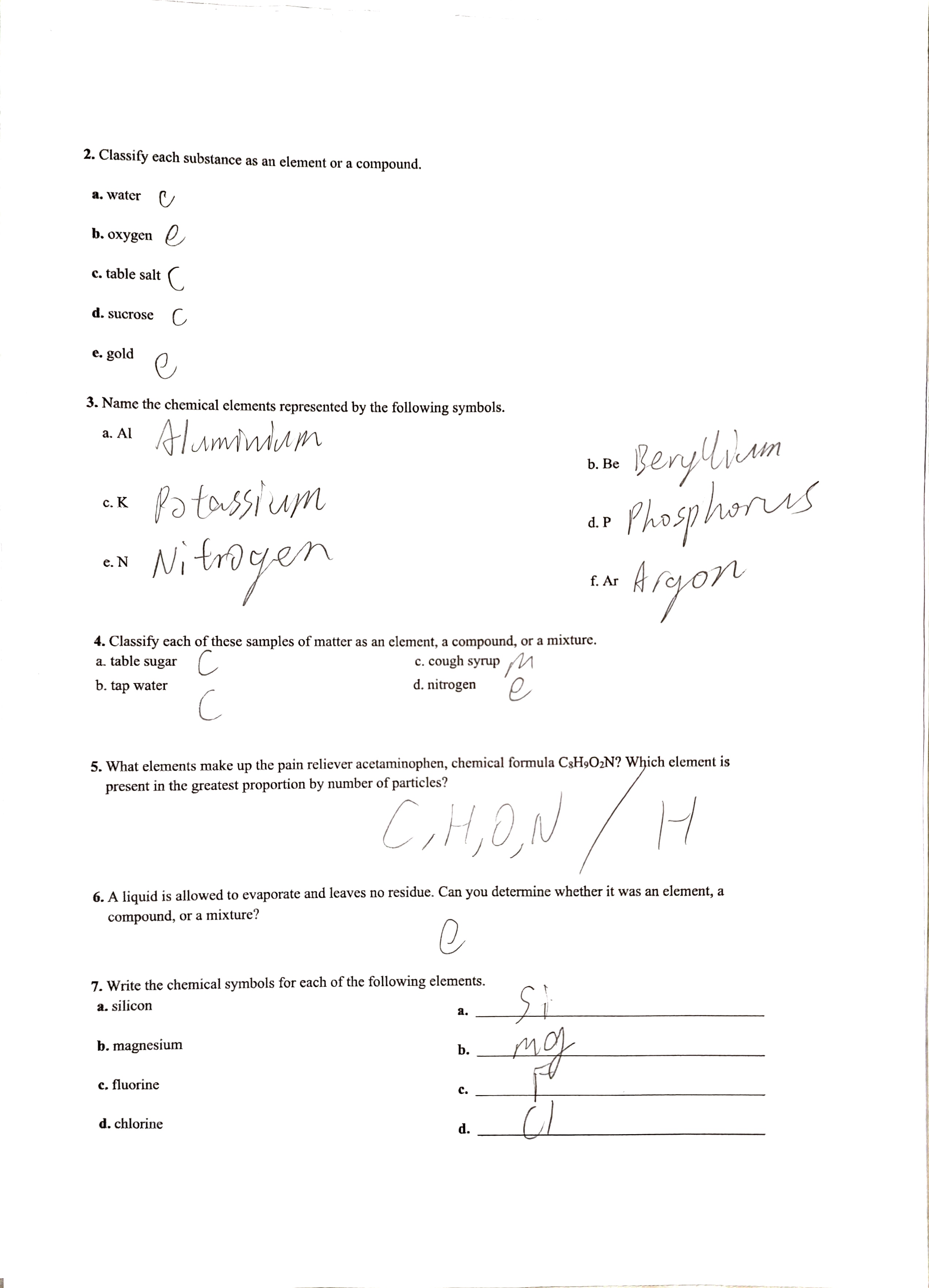
Lesson 5 Homework Page 2 Original Scan
Q2. Classify each substance as an element or a compound:
a. water (C), b. oxygen (e), c. table salt (C), d. sucrose (C), e. gold (e)
ALL 5 CORRECT
Student's Handwritten Answer
a. C, b. e, c. C, d. C, e. e
Correct Reference Solution
a. Compound, b. Element, c. Compound, d. Compound, e. Element
Diagnostic Analysis
100% accurate classification across all 5 substances.
Q3. Name the chemical elements represented by the following symbols:
a. Al, b. Be, c. K, d. P, e. N, f. Ar
PARTIALLY CORRECT (SPELLING)
Student's Handwritten Answer
a. Alumonium, b. Beryllium, c. Potassium, d. Phosphorus, e. Nitrogen, f. Argon
Correct Reference Solution
a. Aluminum (or Aluminium), b. Beryllium, c. Potassium, d. Phosphorus, e. Nitrogen, f. Argon
Diagnostic Analysis
Items b through f are completely correct. For item a, the student misspelled aluminum as "Alumonium". The standard accepted spelling is Aluminum (US) or Aluminium (IUPAC).
Q4. Classify each of these samples of matter as an element, a compound, or a mixture:
a. table sugar, b. tap water, c. cough syrup, d. nitrogen
1 INCORRECT, 3 CORRECT
Student's Handwritten Answer
a. C, b. C, c. M, d. e
Correct Reference Solution
a. Compound (C), b. Mixture (M), c. Mixture (M), d. Element (e)
Diagnostic Analysis
Error on 4b (tap water): While pure distilled water is a compound (H₂O), tap water is not pure; it contains dissolved minerals (calcium, magnesium, chloride), disinfectants (chlorine), and gases. Therefore, tap water is a homogeneous Mixture (M).
Q5. What elements make up the pain reliever acetaminophen, chemical formula C₈H₉O₂N? Which element is present in the greatest proportion by number of particles?
CORRECT
Student's Handwritten Answer
C, H, O, N / H
Correct Reference Solution
Elements: Carbon, Hydrogen, Oxygen, Nitrogen; Greatest proportion: Hydrogen (H)
Diagnostic Analysis
Accurate. In one molecule, there are 8 C, 9 H, 2 O, and 1 N atom (total 20 atoms). Hydrogen comprises 9/20 (45.0%) of the total particle count, which is the largest proportion.
Q6. A liquid is allowed to evaporate and leaves no residue. Can you determine whether it was an element, a compound, or a mixture?
INCORRECT
Student's Handwritten Answer
e
Correct Reference Solution
No (You cannot determine this)
Diagnostic Analysis
The student responded with "e" (implying element). This is fundamentally incorrect. If a liquid evaporates completely without residue, it could be:
  • A pure liquid element (e.g., liquid bromine, Br₂).
  • A pure liquid compound (e.g., pure water, H₂O, or pure ethanol, C₂H₅OH).
  • A homogeneous mixture of volatile liquids (e.g., a mixture of ethanol and water).
Because volatile compounds and volatile liquid mixtures also evaporate completely without leaving a solid residue, evaporation alone cannot distinguish between them. The correct answer is No, you cannot determine it.
Q7. Write the chemical symbols for each of the following elements:
a. silicon, b. magnesium, c. fluorine, d. chlorine
1 SYNTAX ERROR, 3 CORRECT
Student's Handwritten Answer
a. Si, b. mg, c. F, d. Cl
Correct Reference Solution
a. Si, b. Mg, c. F, d. Cl
Diagnostic Analysis
Error on 7b (magnesium): The student wrote lowercase mg. In chemical notation (IUPAC standards), element symbols MUST start with a capitalized first letter followed by a lowercase second letter: Mg. The all-lowercase symbol mg is universally recognized as the abbreviation for milligrams (a unit of mass), not an element symbol.
Sheet 3 / 10 • Lesson Six Homework (Part I)
微信图片_20260828182326_46_91.jpg
🔍 Click to view original handwritten sheet image (Sheet 3)
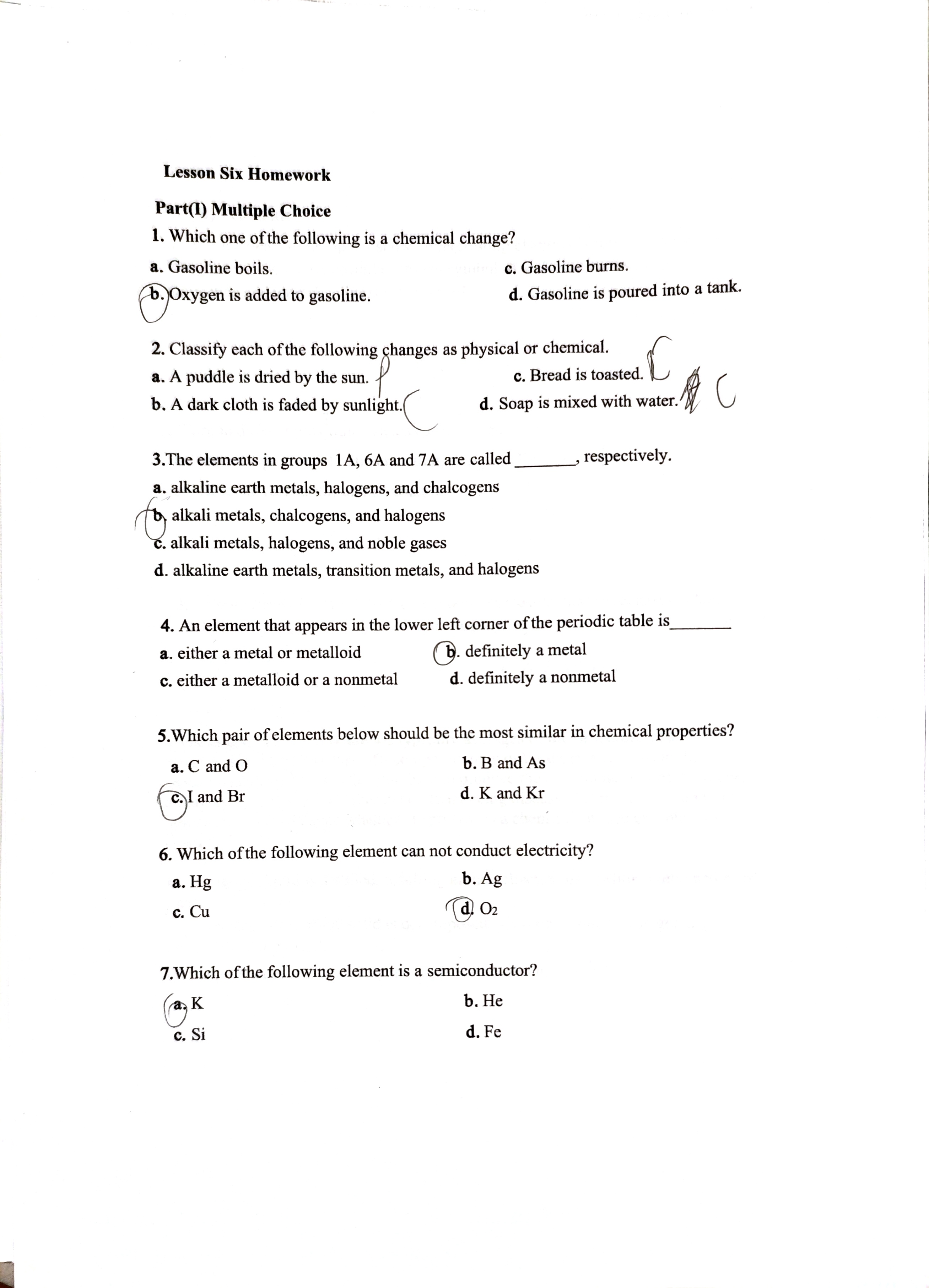
Lesson 6 Homework Part I Original Scan
Part I - 1. Which one of the following is a chemical change?
  • a. Gasoline boils.
  • b. Oxygen is added to gasoline.
  • c. Gasoline burns.
  • d. Gasoline is poured into a tank.
INCORRECT
Student's Handwritten Answer
b. Oxygen is added to gasoline (circled)
Correct Reference Solution
c. Gasoline burns.
Diagnostic Analysis
Boiling (a) is a physical phase change, and pouring (d) is mechanical transport. Adding oxygen to liquid gasoline without ignition (b) merely dissolves oxygen gas in the hydrocarbon solvent, which is a physical mixture. Gasoline burns (c) is combustion: hydrocarbons chemically react with oxygen at high temperatures to form new chemical substances (CO₂ and H₂O) and release energy. Thus, c is the only chemical change.
Part I - 2. Classify each of the following changes as physical or chemical:
a. A puddle is dried by the sun.
b. A dark cloth is faded by sunlight.
c. Bread is toasted.
d. Soap is mixed with water.
1 INCORRECT, 3 CORRECT
Student's Handwritten Answer
a. P, b. C, c. C, d. C
Correct Reference Solution
a. Physical (P), b. Chemical (C), c. Chemical (C), d. Physical (P)
Diagnostic Analysis
Error on 2d (Soap mixed with water): Dissolving soap in water is a Physical change (P). The soap molecules disperse and aggregate into spherical micelles through intermolecular forces without forming or breaking covalent chemical bonds. Soap molecules retain their chemical identity and can be recovered unaltered by evaporating the water.
Part I - 3. The elements in groups 1A, 6A and 7A are called ____, respectively.
  • a. alkaline earth metals, halogens, and chalcogens
  • b. alkali metals, chalcogens, and halogens
  • c. alkali metals, halogens, and noble gases
  • d. alkaline earth metals, transition metals, and halogens
CORRECT
Student's Handwritten Answer
b (circled)
Correct Reference Solution
b. alkali metals, chalcogens, and halogens
Diagnostic Analysis
Accurate. Group 1A = Alkali metals; Group 6A (16) = Chalcogens; Group 7A (17) = Halogens.
Part I - 4. An element that appears in the lower left corner of the periodic table is ____
  • a. either a metal or metalloid
  • b. definitely a metal
  • c. either a metalloid or a nonmetal
  • d. definitely a nonmetal
CORRECT
Student's Handwritten Answer
b. definitely a metal (circled)
Correct Reference Solution
b. definitely a metal
Diagnostic Analysis
Accurate. Metallic character increases down a group and from right to left across a period, making elements in the lower left (e.g., Cs, Fr) the most metallic elements.
Part I - 5. Which pair of elements below should be the most similar in chemical properties?
  • a. C and O
  • b. B and As
  • c. I and Br
  • d. K and Kr
CORRECT
Student's Handwritten Answer
c. I and Br (circled)
Correct Reference Solution
c. I and Br
Diagnostic Analysis
Accurate. Elements in the same periodic group have the same number of valence electrons and exhibit the most similar chemical behavior. Iodine and Bromine are both in Group 7A (halogens).
Part I - 6. Which of the following element can not conduct electricity?
  • a. Hg
  • b. Ag
  • c. Cu
  • d. O₂
CORRECT
Student's Handwritten Answer
d. O₂ (circled)
Correct Reference Solution
d. O₂
Diagnostic Analysis
Accurate. Hg (liquid metal), Ag, and Cu are metals with sea-of-electrons conductivity. Oxygen is a molecular nonmetal and an electrical insulator.
Part I - 7. Which of the following element is a semiconductor?
  • a. K
  • b. He
  • c. Si
  • d. Fe
INCORRECT
Student's Handwritten Answer
a. K (circled)
Correct Reference Solution
c. Si
Diagnostic Analysis
Potassium (K) and iron (Fe) are metallic conductors. Helium (He) is a noble gas insulator. Silicon (Si) is a metalloid with an intermediate energy bandgap (~1.1 eV) between conductors and insulators, which defines a semiconductor. Correct choice is c.
Sheet 4 / 10 • Lesson Six Homework (Part II)
微信图片_20260828182325_45_91.jpg
🔍 Click to view original handwritten sheet image (Sheet 4)
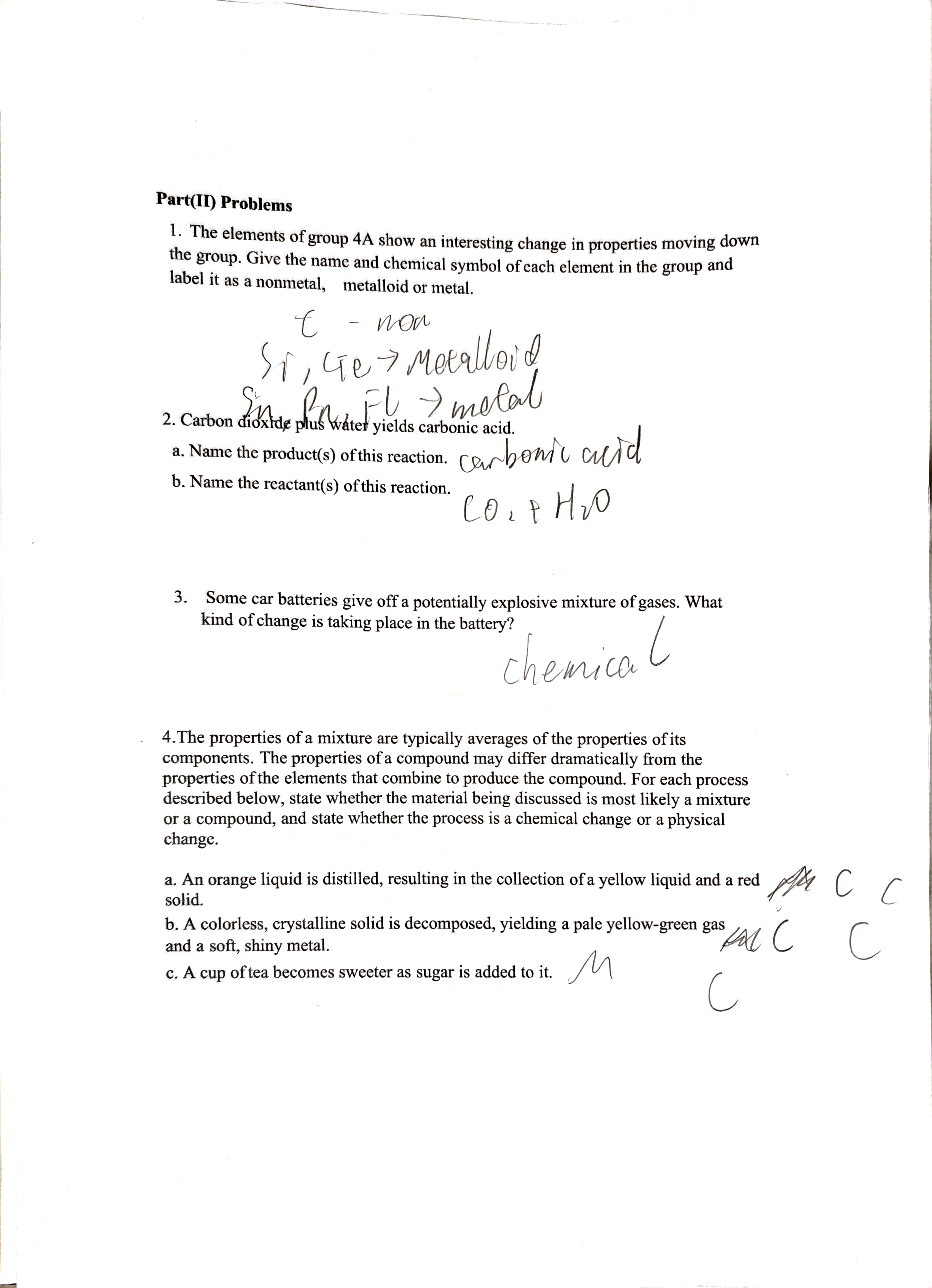
Lesson 6 Homework Part II Original Scan
Part II - 1. The elements of group 4A show an interesting change in properties moving down the group. Give the name and chemical symbol of each element in the group and label it as a nonmetal, metalloid or metal.
PARTIALLY CORRECT (OMISSIONS)
Student's Handwritten Answer
C - non
Si, Ge -> metalloid
Sn, Pb, Fl -> metal
Correct Reference Solution
Carbon (C) - Nonmetal
Silicon (Si) & Germanium (Ge) - Metalloids
Tin (Sn), Lead (Pb) & Flerovium (Fl) - Metals
Diagnostic Analysis
The classifications are chemically accurate. However, the student omitted the names of all elements (Carbon, Silicon, Germanium, Tin, Lead, Flerovium) despite explicit prompt instructions: "Give the name and chemical symbol of each element". The student also informally abbreviated nonmetal as "non".
Part II - 2. Carbon dioxide plus water yields carbonic acid.
a. Name the product(s) of this reaction.
b. Name the reactant(s) of this reaction.
PARTIALLY CORRECT
Student's Handwritten Answer
a. carbonic acid
b. CO₂ + H₂O
Correct Reference Solution
a. Carbonic acid
b. Carbon dioxide and water
Diagnostic Analysis
Part 2a is correct. For 2b, the question asked to "Name the reactant(s)". Writing chemical formulas (CO₂ + H₂O) shows conceptual understanding, but the prompt requested the substance names: carbon dioxide and water.
Part II - 3. Some car batteries give off a potentially explosive mixture of gases. What kind of change is taking place in the battery?
CORRECT
Student's Handwritten Answer
chemical
Correct Reference Solution
Chemical change
Diagnostic Analysis
Accurate. The battery undergoes an electrochemical reaction (electrolysis of water) producing hydrogen and oxygen gases.
Part II - 4. For each process described below, state whether the material being discussed is most likely a mixture (M) or a compound (C), and state whether the process is a chemical change (C) or a physical change (P):
  • a. An orange liquid is distilled, resulting in the collection of a yellow liquid and a red solid.
  • b. A colorless, crystalline solid is decomposed, yielding a pale yellow-green gas and a soft, shiny metal.
  • c. A cup of tea becomes sweeter as sugar is added to it.
2 INCORRECT, 1 CORRECT
Student's Handwritten Answer
a. C (Compound), C (Chemical change)
b. C (Compound), C (Chemical change)
c. M (Mixture), C (Chemical change)
Correct Reference Solution
a. Mixture (M), Physical change (P)
b. Compound (C), Chemical change (C)
c. Mixture (M), Physical change (P)
Diagnostic Analysis
Critical Errors on 4a and 4c:
4a: Distillation is a physical separation method based on boiling point differences. Separating the orange liquid into a yellow liquid and red solid without breaking chemical bonds means the orange liquid was a Mixture (M), and distillation is a Physical change (P). The student wrote C, C.
4b: Decomposition into elements (metal and halogen gas) breaks chemical bonds, so the starting solid was a Compound (C) and the process is a Chemical change (C) (Student: correct).
4c: Adding sugar to tea forms a solution, which is a Mixture (M) (Student: correct). However, dissolving sugar is a Physical change (P), not a chemical change (Student incorrectly wrote C).
Sheet 5 / 10 • Lesson 7 Homework (Part I)
微信图片_20260828182324_44_91.jpg
🔍 Click to view original handwritten sheet image (Sheet 5)
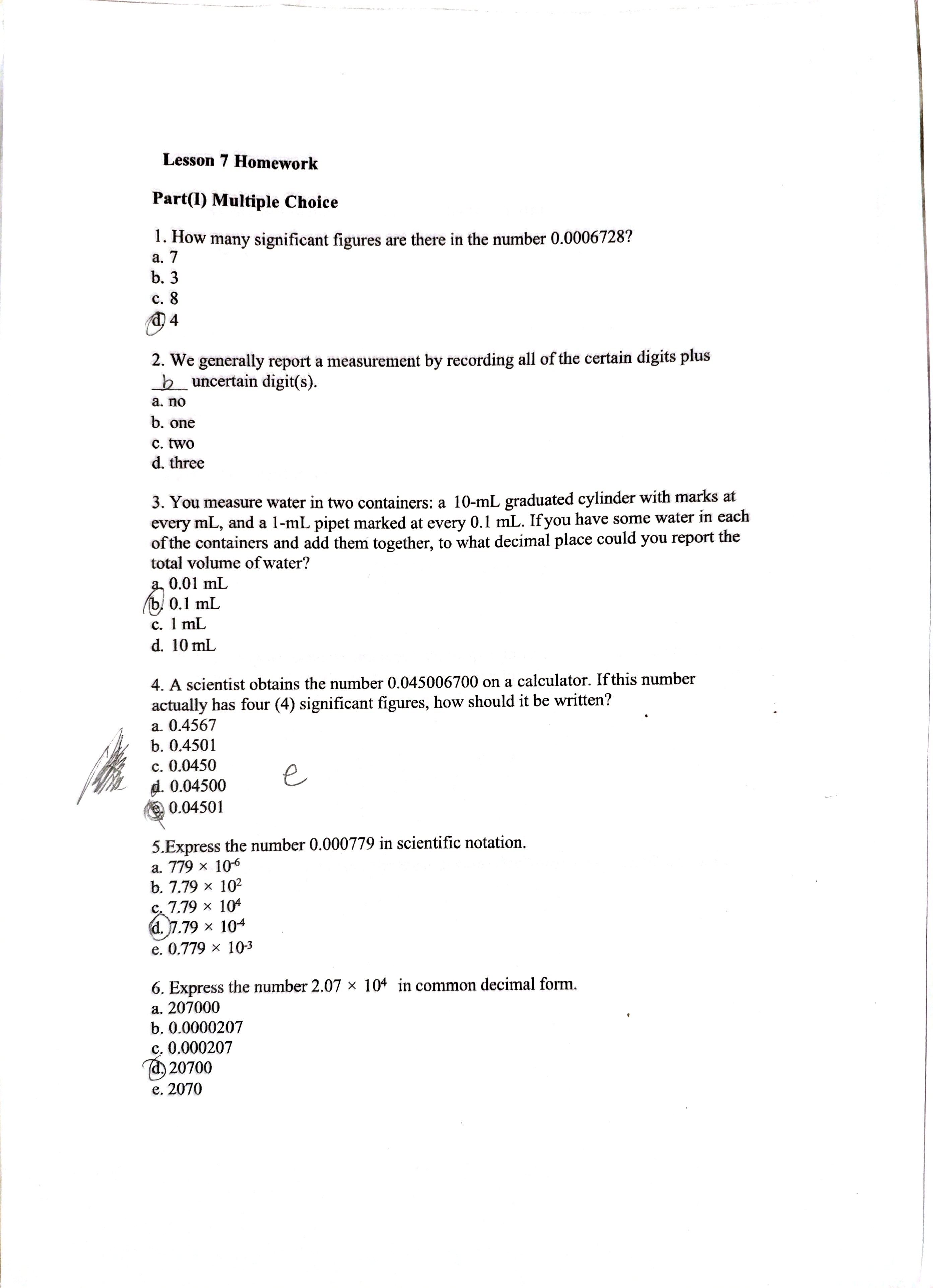
Lesson 7 Homework Part I Original Scan
Part I - 1. How many significant figures are there in the number 0.0006728?
  • a. 7    b. 3    c. 8    d. 4
CORRECT
Student's Handwritten Answer
d (4) (circled)
Correct Reference Solution
d. 4
Diagnostic Analysis
Accurate. Leading zeros before the first non-zero digit are non-significant placeholders. Digits 6, 7, 2, 8 are significant.
Part I - 2. We generally report a measurement by recording all of the certain digits plus ____ uncertain digit(s).
  • a. no    b. one    c. two    d. three
CORRECT
Student's Handwritten Answer
b (one)
Correct Reference Solution
b. one
Diagnostic Analysis
Accurate. Standard scientific practice records all certain digits plus exactly one estimated (uncertain) digit.
Part I - 3. You measure water in two containers: a 10-mL graduated cylinder with marks at every mL, and a 1-mL pipet marked at every 0.1 mL. If you have some water in each of the containers and add them together, to what decimal place could you report the total volume of water?
  • a. 0.01 mL    b. 0.1 mL    c. 1 mL    d. 10 mL
CORRECT
Student's Handwritten Answer
b (0.1 mL) (circled)
Correct Reference Solution
b. 0.1 mL
Diagnostic Analysis
Accurate. The 10-mL graduated cylinder allows estimation to tenths (0.1 mL). In addition, precision is governed by the least precise decimal position (0.1 mL).
Part I - 4. A scientist obtains the number 0.045006700 on a calculator. If this number actually has four (4) significant figures, how should it be written?
  • a. 0.4567    b. 0.4501    c. 0.0450    d. 0.04500    e. 0.04501
CORRECT
Student's Handwritten Answer
e (0.04501)
Correct Reference Solution
e. 0.04501
Diagnostic Analysis
Accurate. The first 4 significant digits are 4, 5, 0, 0 followed by 6, which rounds up to 0.04501.
Part I - 5. Express the number 0.000779 in scientific notation.
  • a. 779 × 10⁻⁶    b. 7.79 × 10²    c. 7.79 × 10⁴    d. 7.79 × 10⁻⁴    e. 0.779 × 10⁻³
CORRECT
Student's Handwritten Answer
d. 7.79 × 10⁻⁴
Correct Reference Solution
d. 7.79 × 10⁻⁴
Diagnostic Analysis
Accurate. Moving the decimal point 4 places to the right yields 7.79 × 10⁻⁴.
Part I - 6. Express the number 2.07 × 10⁴ in common decimal form.
  • a. 207000    b. 0.0000207    c. 0.000207    d. 20700    e. 2070
CORRECT
Student's Handwritten Answer
d. 20700
Correct Reference Solution
d. 20700
Diagnostic Analysis
Accurate. 2.07 × 10,000 = 20,700.
Sheet 6 / 10 • Lesson 7 (Part II - Conservation of Mass)
微信图片_20260828182322_42_91.jpg
🔍 Click to view original handwritten sheet image (Sheet 6)
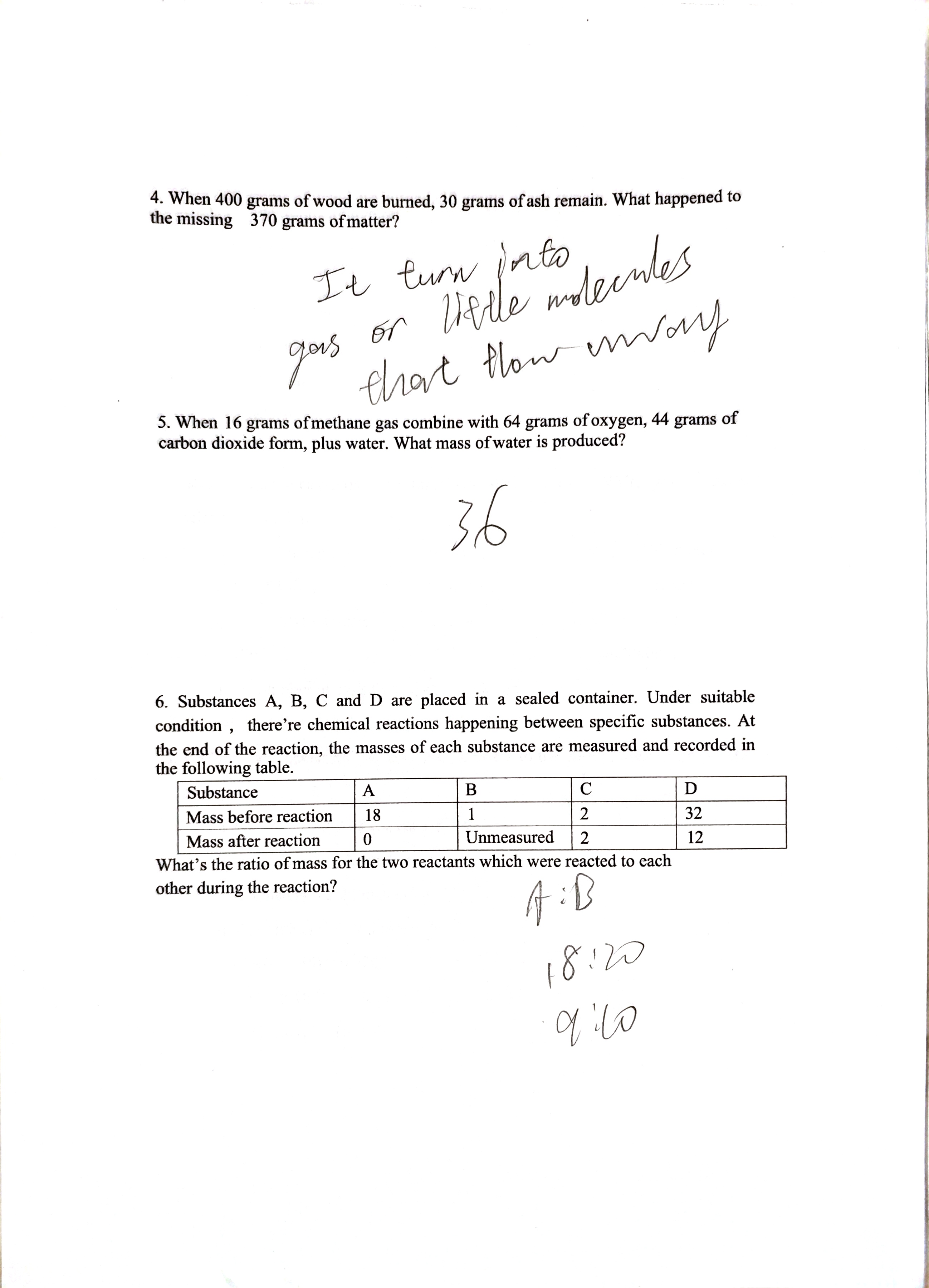
Lesson 7 Homework Part II Original Scan
Q4. When 400 grams of wood are burned, 30 grams of ash remain. What happened to the missing 370 grams of matter?
CORRECT
Student's Handwritten Answer
It turn into gas or little molecules that flow away
Correct Reference Solution
Converted into gaseous combustion products (carbon dioxide and water vapor) and smoke that dispersed into the air
Diagnostic Analysis
The student's explanation captures the core scientific principle accurately. Wood reacts with atmospheric oxygen during combustion to produce carbon dioxide (CO₂) and water vapor (H₂O) gases that escape into the surrounding atmosphere, adhering strictly to the Law of Conservation of Mass.
Q5. When 16 grams of methane gas combine with 64 grams of oxygen, 44 grams of carbon dioxide form, plus water. What mass of water is produced?
PARTIALLY CORRECT (NO UNIT)
Student's Handwritten Answer
36
Correct Reference Solution
36 g (or 36 grams)
Diagnostic Analysis
The numerical calculation is correct: Total reactant mass = 16 g + 64 g = 80 g; Mass of water = 80 g - 44 g = 36 g. However, the student wrote only the bare number "36" without specifying the physical unit of measurement. In science and chemistry, numbers without units are incomplete; it must be written as 36 g.
Q6. Substances A, B, C and D are placed in a sealed container. Under suitable condition, there're chemical reactions happening between specific substances. At the end of the reaction, the masses of each substance are measured and recorded in the following table.
SubstanceABCD
Mass before reaction (g)181232
Mass after reaction (g)0Unmeasured212
What's the ratio of mass for the two reactants which were reacted to each other during the reaction?
INCORRECT (WRONG REACTANT LABELED)
Student's Handwritten Answer
A:B
18:20
9:10
Correct Reference Solution
A : D = 18 : 20 = 9 : 10
Diagnostic Analysis
Conceptual Misidentification of Reactants:
Let us calculate the mass change ($\Delta m = m_{\text{after}} - m_{\text{before}}$) for each substance:
• Substance A: 0 - 18 = -18 g (Mass decreased $\rightarrow$ Reactant)
• Substance C: 2 - 2 = 0 g (Mass unchanged $\rightarrow$ Catalyst or spectator)
• Substance D: 12 - 32 = -20 g (Mass decreased $\rightarrow$ Reactant)
• By Conservation of Mass, the mass increase for substance B is: $\Delta m_B = -(-18 + 0 - 20) = \mathbf{+38\text{ g}}$ (Mass increased $\rightarrow$ Product). Final mass of B = 1 + 38 = 39 g.
The two reactants that reacted are A and D (NOT A and B). While the student computed the numerical ratio 18:20 = 9:10 correctly, they mistakenly labeled it A:B. Substance B is the reaction product! The correct ratio is A : D = 9 : 10.
Sheet 7 / 10 • Scientific Notation & Calculations
微信图片_20260828182323_43_91.jpg
🔍 Click to view original handwritten sheet image (Sheet 7)
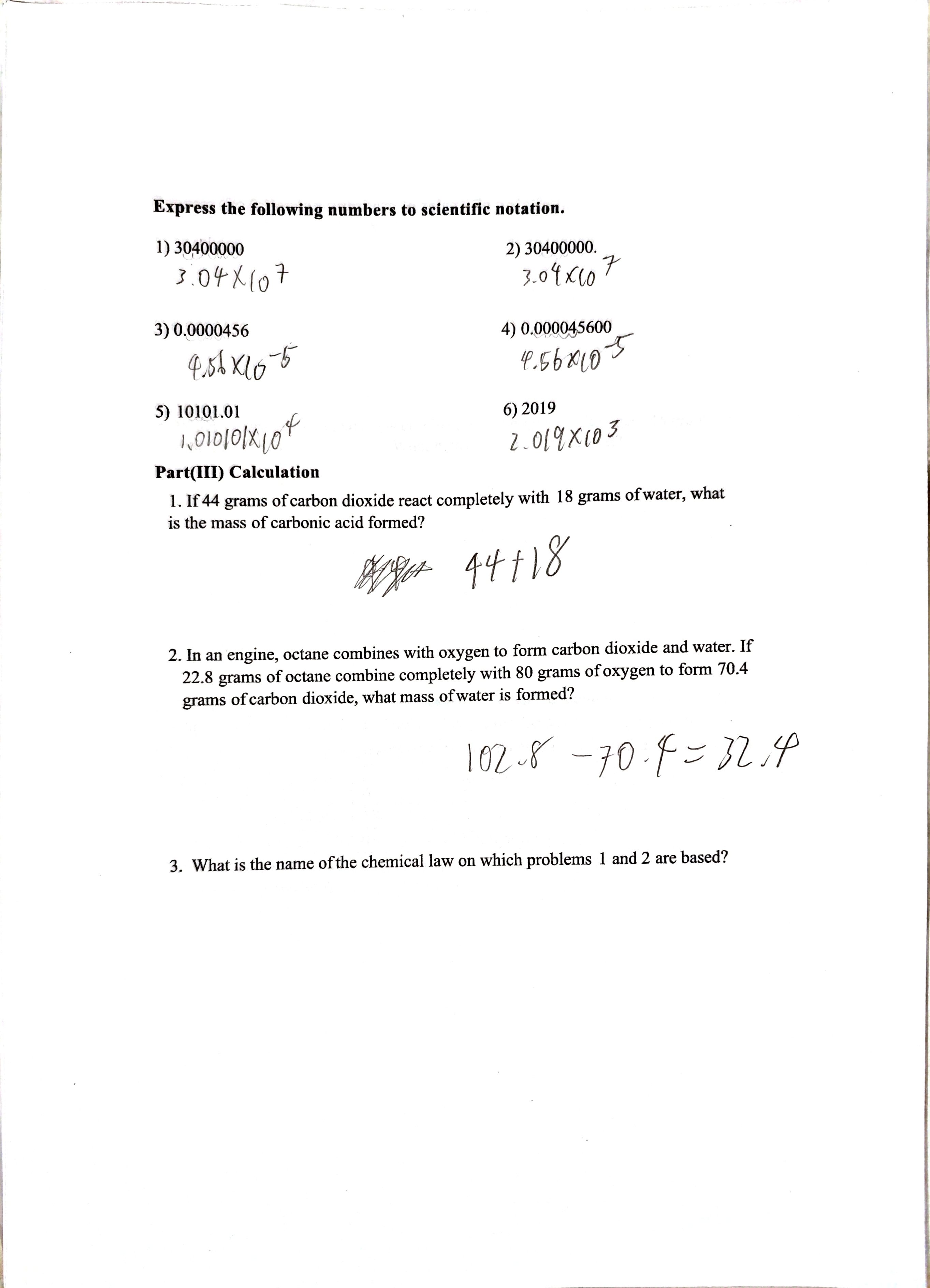
Lesson 8 Calculations Original Scan
Notation 1. Express the following numbers to scientific notation: 30400000
CORRECT
Student's Handwritten Answer
3.04 × 10⁷
Correct Reference Solution
3.04 × 10⁷
Diagnostic Analysis
Accurate (3 significant figures).
Notation 2. Express the following numbers to scientific notation: 30400000. (Notice explicit decimal point)
INCORRECT (SIG FIG ERROR)
Student's Handwritten Answer
3.04 × 10⁷
Correct Reference Solution
3.0400000 × 10⁷
Diagnostic Analysis
Significant Figure Rule Violation: The explicit terminal decimal point in 30400000. indicates that all zeros are significant digits (8 significant figures). When converting to scientific notation, the number of significant figures must be conserved. Writing 3.04 × 10⁷ discards 5 significant figures. The correct form is 3.0400000 × 10⁷.
Notation 3. Express the following numbers to scientific notation: 0.0000456
CORRECT
Student's Handwritten Answer
4.56 × 10⁻⁵
Correct Reference Solution
4.56 × 10⁻⁵
Diagnostic Analysis
Accurate (3 significant figures).
Notation 4. Express the following numbers to scientific notation: 0.000045600
INCORRECT (SIG FIG ERROR)
Student's Handwritten Answer
4.56 × 10⁻⁵
Correct Reference Solution
4.5600 × 10⁻⁵
Diagnostic Analysis
Significant Figure Rule Violation: Trailing zeros to the right of the decimal point in a measured quantity are significant. Therefore, 0.000045600 has 5 significant figures (4, 5, 6, and both trailing zeros). Writing 4.56 × 10⁻⁵ drops two significant figures. The correct scientific notation is 4.5600 × 10⁻⁵.
Notation 5. Express the following numbers to scientific notation: 10101.01
CORRECT
Student's Handwritten Answer
1.010101 × 10⁴
Correct Reference Solution
1.010101 × 10⁴
Diagnostic Analysis
Accurate (7 significant figures).
Notation 6. Express the following numbers to scientific notation: 2019
CORRECT
Student's Handwritten Answer
2.019 × 10³
Correct Reference Solution
2.019 × 10³
Diagnostic Analysis
Accurate (4 significant figures).
Part III - 1. If 44 grams of carbon dioxide react completely with 18 grams of water, what is the mass of carbonic acid formed?
PARTIALLY CORRECT (INCOMPLETE)
Student's Handwritten Answer
44 + 18
Correct Reference Solution
62 g (or 62 grams)
Diagnostic Analysis
The setup (44 + 18) is correct based on conservation of mass. However, the student stopped at writing the arithmetic expression without computing the final sum (62) or providing the unit (g).
Part III - 2. In an engine, octane combines with oxygen to form carbon dioxide and water. If 22.8 grams of octane combine completely with 80 grams of oxygen to form 70.4 grams of carbon dioxide, what mass of water is formed?
PARTIALLY CORRECT (NO UNIT)
Student's Handwritten Answer
102.8 - 70.4 = 32.4
Correct Reference Solution
32.4 g (or 32.4 grams)
Diagnostic Analysis
Calculation is completely correct: Total reactants = 22.8 g + 80 g = 102.8 g; water produced = 102.8 g - 70.4 g = 32.4 g. However, the student omitted the physical unit (g).
Part III - 3. What is the name of the chemical law on which problems 1 and 2 are based?
INCORRECT (BLANK)
Student's Handwritten Answer
[Left completely blank]
Correct Reference Solution
The Law of Conservation of Mass
Diagnostic Analysis
The question was left unanswered. The governing law stating that mass is neither created nor destroyed during chemical reactions is the Law of Conservation of Mass (formulated by Antoine Lavoisier).
Sheet 8 / 10 • Lesson 8 Homework (Significant Figures Practice)
微信图片_20260828182321_41_91.jpg
🔍 Click to view original handwritten sheet image (Sheet 8)
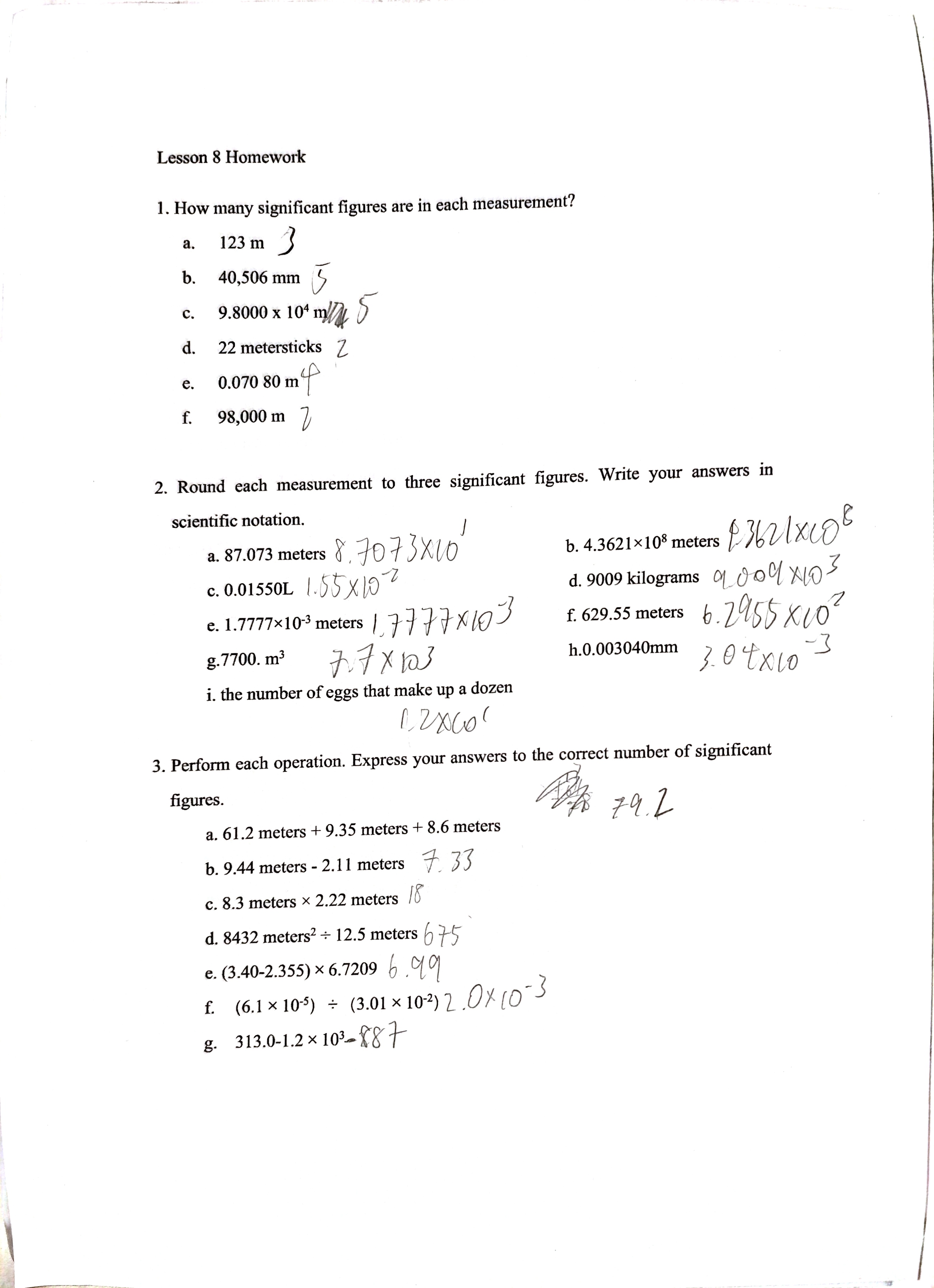
Lesson 8 Homework Significant Figures Original Scan
Q1 a-c, e-f. How many significant figures are in each measurement?
a. 123 m (3), b. 40,506 mm (5), c. 9.8000 × 10⁴ m (5), e. 0.070 80 m (4), f. 98,000 m (2)
CORRECT
Student's Handwritten Answer
a. 3, b. 5, c. 5, e. 4, f. 2
Correct Reference Solution
a. 3, b. 5, c. 5, e. 4, f. 2
Diagnostic Analysis
All five entries are correctly determined following standard significant figure rules.
Q1d. How many significant figures are in each measurement? 22 metersticks
INCORRECT
Student's Handwritten Answer
2
Correct Reference Solution
Infinite (∞) / Exact number
Diagnostic Analysis
Exact Number Concept: "Metersticks" is a countable discrete physical object, not an inexact quantity read from a graduated scale. Counted numbers and defined quantities have no uncertainty and possess an infinite number of significant figures (∞). The student treated it as a measured quantity with 2 sig figs.
Q2. Round each measurement to three significant figures. Write your answers in scientific notation:
a. 87.073 meters  |  b. 4.3621×10⁸ meters  |  c. 0.01550 L  |  d. 9009 kilograms  |  e. 1.7777×10⁻³ meters  |  f. 629.55 meters  |  g. 7700. m³  |  h. 0.003040 mm  |  i. number of eggs in a dozen
7 INCORRECT, 2 CORRECT
Student's Handwritten Answer
a. 8.7073 × 10¹  |  b. 4.3621 × 10⁸
c. 1.55 × 10⁻² (✓)  |  d. 9.009 × 10³
e. 1.7777 × 10⁻³  |  f. 6.2955 × 10²
g. 7.7 × 10³  |  h. 3.04 × 10⁻³ (✓)
i. 1.2 × 10¹
Correct Reference Solution (All 3 Sig Figs in Scientific Notation)
a. 8.71 × 10¹ m  |  b. 4.36 × 10⁸ m
c. 1.55 × 10⁻² L  |  d. 9.01 × 10³ kg
e. 1.78 × 10⁻³ m  |  f. 6.30 × 10² m
g. 7.70 × 10³ m³  |  h. 3.04 × 10⁻³ mm
i. 1.20 × 10¹ (or exact count ∞)
Diagnostic Analysis
Major Misunderstanding of Instructions:
The student converted numbers into scientific notation but completely failed to perform the required rounding to three significant figures for items a, b, d, e, and f!
• In a (87.073 m), the student wrote 8.7073 × 10¹ (kept 5 sig figs). It must be 8.71 × 10¹ m.
• In b (4.3621 × 10⁸ m), student wrote 4.3621 × 10⁸ (kept 5 sig figs). Must be 4.36 × 10⁸ m.
• In d (9009 kg), student wrote 9.009 × 10³ (kept 4 sig figs). Must be 9.01 × 10³ kg.
• In e (1.7777 × 10⁻³ m), student wrote 1.7777 × 10⁻³ (kept 5 sig figs). Must be 1.78 × 10⁻³ m.
• In f (629.55 m), student wrote 6.2955 × 10² (kept 5 sig figs). Must round up to 6.30 × 10² m.
• In g (7700. m³), student wrote 7.7 × 10³ (under-rounded to 2 sig figs). 3 sig figs requires 7.70 × 10³ m³.
• In i (dozen = 12), student wrote 1.2 × 10¹ (only 2 sig figs). 3 sig figs requires 1.20 × 10¹.
Q3. Perform each operation. Express your answers to the correct number of significant figures:
a. 61.2 m + 9.35 m + 8.6 m
b. 9.44 m - 2.11 m
c. 8.3 m × 2.22 m
d. 8432 m² ÷ 12.5 m
e. (3.40 - 2.355) × 6.7209
f. (6.1 × 10⁻⁵) ÷ (3.01 × 10⁻²)
g. 313.0 - 1.2 × 10³
2 INCORRECT, 5 CORRECT
Student's Handwritten Answer
a. 79.2 (✓)  |  b. 7.33 (✓)
c. 18 (✓)  |  d. 675 (✓)
e. 6.99 (✗)
f. 2.0 × 10⁻³ (✓)
g. -887 (✗)
Correct Reference Solution
a. 79.2 m  |  b. 7.33 m
c. 18 m²  |  d. 675 m
e. 7.02
f. 2.0 × 10⁻³
g. -900 (or -9 × 10²)
Diagnostic Analysis
Items a, b, c, d, and f are correctly calculated.
Error on 3e [(3.40 - 2.355) × 6.7209]: First, subtraction: 3.40 - 2.355 = 1.045. Since 3.40 has 2 decimal places, this intermediate difference is significant to the hundredths place (3 sig figs). Multiplying while carrying full precision: 1.045 × 6.7209 = 7.02334 $\rightarrow$ rounded to 3 sig figs = 7.02. The student got 6.99 because they prematurely truncated 1.045 to 1.04 before multiplying (1.04 × 6.7209 = 6.9897 $\rightarrow$ 6.99). Truncating intermediate steps leads to compounded rounding errors.
Error on 3g [313.0 - 1.2 × 10³]: 1.2 × 10³ = 1200 has its last significant digit in the hundreds place (±100). In addition/subtraction, the result is limited by the least precise decimal position (the hundreds place). 313.0 - 1200 = -887. Rounding -887 to the hundreds place yields -900 or -9 × 10². The student wrote -887 without applying significant figure rounding.
Sheet 9 / 10 • Lesson 9 Homework (Part I & II)
微信图片_20260828182320_40_91.jpg
🔍 Click to view original handwritten sheet image (Sheet 9)
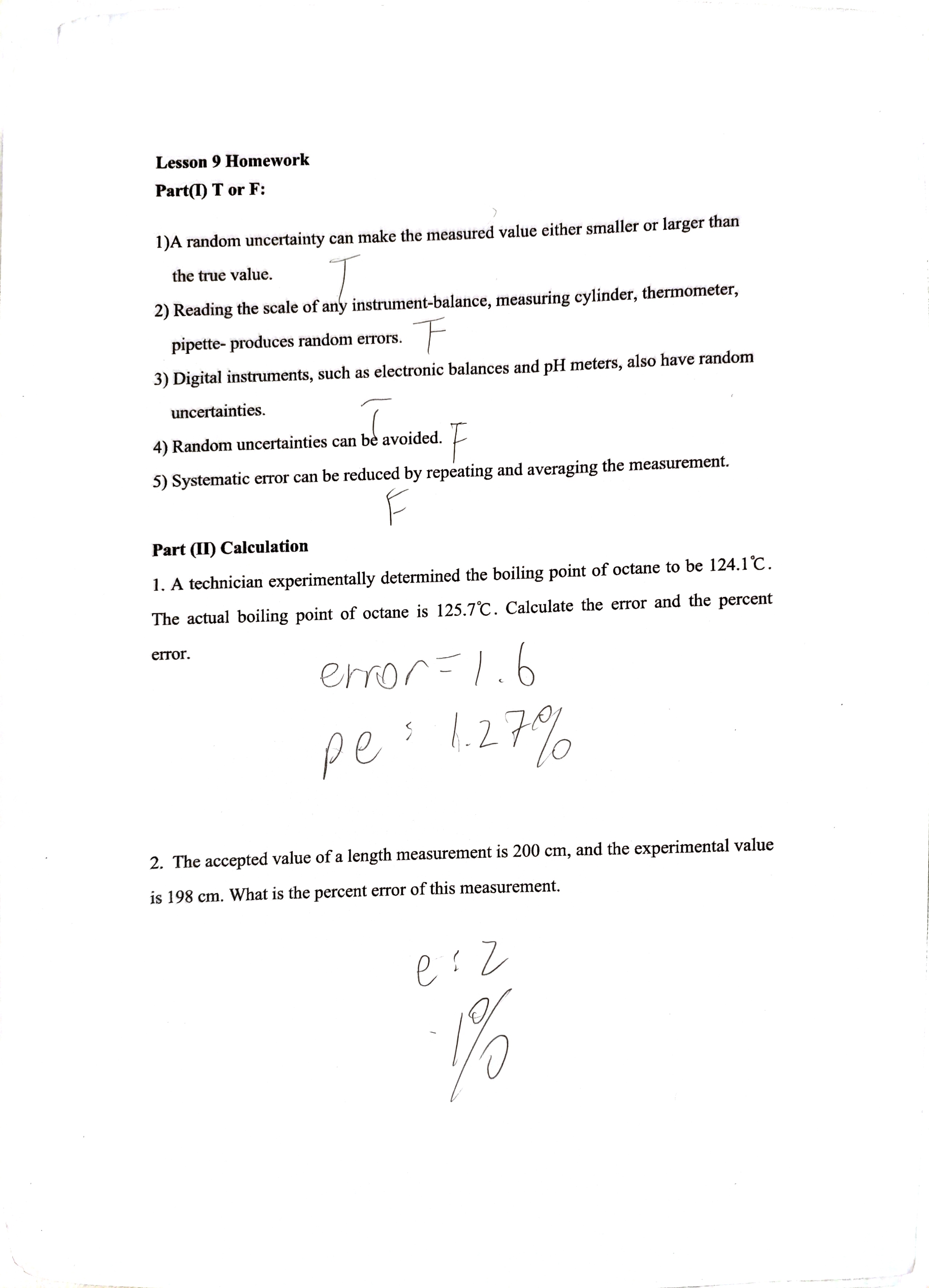
Lesson 9 Homework Part I and II Original Scan
Part I - 1. A random uncertainty can make the measured value either smaller or larger than the true value.
CORRECT
Student's Handwritten Answer
T (True)
Correct Reference Solution
True (T)
Diagnostic Analysis
Accurate. Random uncertainties fluctuate in both positive and negative directions with equal probability.
Part I - 2. Reading the scale of any instrument-balance, measuring cylinder, thermometer, pipette- produces random errors.
INCORRECT
Student's Handwritten Answer
F (False)
Correct Reference Solution
True (T)
Diagnostic Analysis
Misconception regarding Scale Reading: Reading an analogue scale requires human visual interpolation between graduation lines. Fluctuations in eye level (parallax) and subjective estimation between markings vary randomly above and below the line from trial to trial. Therefore, scale reading is a classic source of random error. The statement is True (T).
Part I - 3. Digital instruments, such as electronic balances and pH meters, also have random uncertainties.
CORRECT
Student's Handwritten Answer
T (True)
Correct Reference Solution
True (T)
Diagnostic Analysis
Accurate. Electronic thermal noise, air drafts on balance pans, and digital analog-to-digital rounding noise create random error.
Part I - 4. Random uncertainties can be avoided.
CORRECT
Student's Handwritten Answer
F (False)
Correct Reference Solution
False (F)
Diagnostic Analysis
Accurate. Random uncertainty is an inherent limitation of physical measurements and can never be completely eliminated.
Part I - 5. Systematic error can be reduced by repeating and averaging the measurement.
CORRECT
Student's Handwritten Answer
F (False)
Correct Reference Solution
False (F)
Diagnostic Analysis
Accurate. Systematic errors consistently skew data in one direction. Averaging multiple trials reduces random scatter, but has zero effect on systematic bias.
Part II - 1. A technician experimentally determined the boiling point of octane to be 124.1°C. The actual boiling point of octane is 125.7°C. Calculate the error and the percent error.
CORRECT
Student's Handwritten Answer
error = 1.6
pe = 1.27%
Correct Reference Solution
Error = -1.6°C (or |error| = 1.6°C); Percent Error = 1.27%
Diagnostic Analysis
Numerically accurate: Absolute error = |124.1 - 125.7| = 1.6°C; Percent error = (1.6 / 125.7) × 100% = 1.27287% $\rightarrow$ 1.27%. (Minor note: units like °C should ideally accompany the error value).
Part II - 2. The accepted value of a length measurement is 200 cm, and the experimental value is 198 cm. What is the percent error of this measurement?
CORRECT
Student's Handwritten Answer
e: 2
1%
Correct Reference Solution
Error = 2 cm; Percent Error = 1.0% (or 1%)
Diagnostic Analysis
Accurate: (2 / 200) × 100% = 1.0%.
Sheet 10 / 10 • Accuracy & Precision Analysis (True Mass = 47.32 g)
微信图片_20260828182319_39_91.jpg
🔍 Click to view original handwritten sheet image (Sheet 10)
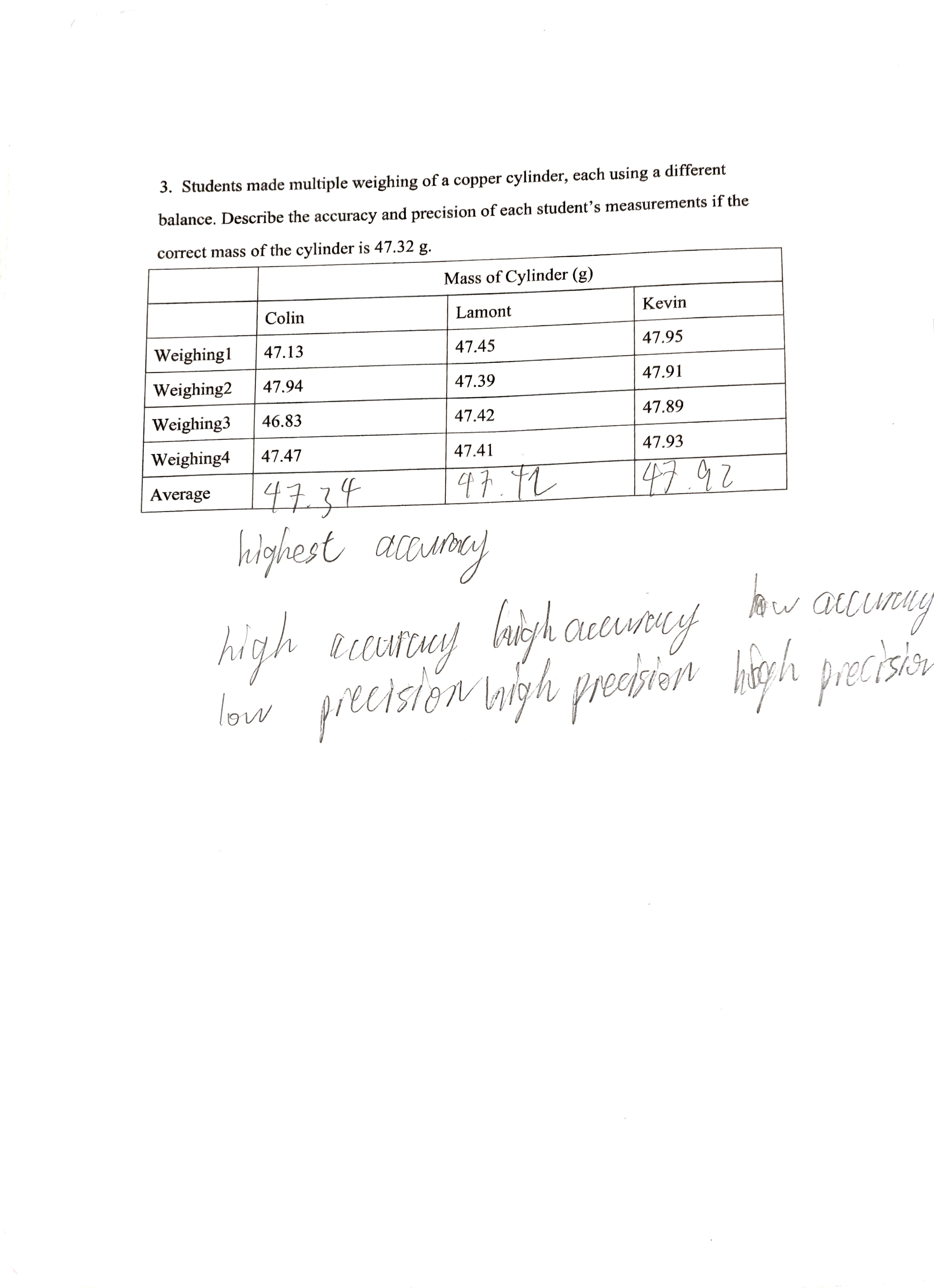
Lesson 9 Problem 3 Balance Measurements Original Scan
Problem 3 - Colin. Students made multiple weighing of a copper cylinder, each using a different balance. Describe the accuracy and precision of each student's measurements if the correct mass of the cylinder is 47.32 g.
Colin's weighings: 47.13 g, 47.94 g, 46.83 g, 47.47 g
CORRECT
Student's Handwritten Answer
Average: 47.34
high accuracy
low precision
Correct Reference Solution
Average = 47.34 g; High accuracy, Low precision
Diagnostic Analysis
Accurate evaluation: • Colin's average = (47.13 + 47.94 + 46.83 + 47.47) / 4 = 189.37 / 4 = 47.3425 g $\approx$ 47.34 g.
• Deviation from true mass (47.32 g) = |47.34 - 47.32| = 0.02 g (Extremely close to true value $\rightarrow$ High accuracy).
• Spread (Range) = 47.94 - 46.83 = 1.11 g (Very wide dispersion $\rightarrow$ Low precision).
Problem 3 - Lamont. Describe the accuracy and precision of Lamont's measurements (True mass = 47.32 g):
Lamont's weighings: 47.45 g, 47.39 g, 47.42 g, 47.41 g
PARTIALLY CORRECT (COMPARISON FLAW)
Student's Handwritten Answer
Average: 47.42
"highest accuracy"
high precision
Correct Reference Solution
Average = 47.42 g; High precision, Moderate accuracy
Diagnostic Analysis
Accuracy Comparison Flaw:
• Lamont's average = (47.45 + 47.39 + 47.42 + 47.41) / 4 = 189.67 / 4 = 47.42 g (Computed correctly).
• Spread = 47.45 - 47.39 = 0.06 g (Extremely tight grouping $\rightarrow$ High precision).
• However, Lamont's average is 0.10 g away from the true mass (47.32 g). Colin's average is only 0.02 g away from true mass. Thus, Colin is 5 times closer to the true value than Lamont. Lamont does not have the "highest accuracy". Lamont's accuracy is intermediate/moderate, while his precision is high.
Problem 3 - Kevin. Describe the accuracy and precision of Kevin's measurements (True mass = 47.32 g):
Kevin's weighings: 47.95 g, 47.91 g, 47.89 g, 47.93 g
CORRECT
Student's Handwritten Answer
Average: 47.92
low accuracy
high precision
Correct Reference Solution
Average = 47.92 g; Low accuracy, High precision
Diagnostic Analysis
Accurate evaluation: • Kevin's average = (47.95 + 47.91 + 47.89 + 47.93) / 4 = 191.68 / 4 = 47.92 g.
• Deviation from true mass = |47.92 - 47.32| = 0.60 g (Far from true value $\rightarrow$ Low accuracy due to a systematic calibration error).
• Spread = 47.95 - 47.89 = 0.06 g (Very tight grouping $\rightarrow$ High precision).

Summary of Core Conceptual Deficiencies & Action Plan

1. Significant Figures in Scientific Notation & Explicit Decimals

Diagnosis: The student routinely ignored terminal decimal points and trailing zeros in decimals (e.g., converting 30400000. to 3.04 × 10⁷ instead of 3.0400000 × 10⁷, and 0.000045600 to 4.56 × 10⁻⁵ instead of 4.5600 × 10⁻⁵). In Lesson 8 Q2, the student simply wrote scientific notation without rounding to the requested 3 significant figures.

Correction Rule: Trailing zeros in a decimal number represent measurement precision and are significant. An explicit terminal decimal point indicates that all preceding zeros are significant.

2. Counted Discrete Quantities (Exact Numbers)

Diagnosis: The student counted significant figures for 22 metersticks as 2 sig figs instead of infinite.

Correction Rule: Counted physical objects (apples, metersticks, molecules) and defined conversion factors are exact numbers with zero measurement uncertainty and infinite ($\infty$) significant figures.

3. Physical vs. Chemical Changes & Mixture Misclassification

Diagnosis: Dissolving soap in water, tea sweetening, and distillation were incorrectly marked as chemical changes. Tap water and stainless steel were misclassified as compounds/elements rather than mixtures.

Correction Rule: Dissolving solutes and physical separation techniques (like distillation) do not break covalent chemical bonds. Alloys (stainless steel) and non-purified water (tap water) contain multiple substances and are homogeneous mixtures.

4. Conservation of Mass Reactant Identification

Diagnosis: In Lesson 7 Q6, the student calculated the numerical ratio 18:20 correctly, but labeled it as A:B instead of A:D.

Correction Rule: Reactants are substances whose mass decreases ($\Delta m < 0$). Products are substances whose mass increases ($\Delta m > 0$). Substance B gained 38 g and was the product; A and D were the two reactants.

5. IUPAC Chemical Symbol Capitalization & Units

Diagnosis: The student wrote magnesium as mg (milligram) instead of Mg, and omitted physical units (e.g., grams, °C) in calculation answers.

Correction Rule: Chemical symbols must strictly follow the format Capitalized First Letter + Lowercase Second Letter. Numerical results in science must always carry their associated physical measurement units.